latest news
Toxic strawberries were shipped to Taiwan! Over 3 tons of strawberries exceeded pesticide limits; imported basil leaves from a small mill also malfunctioned
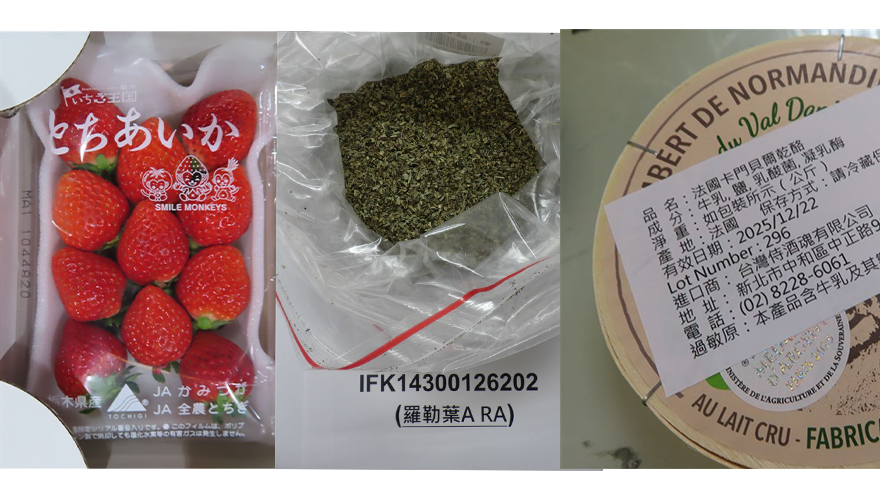
The Food and Drug Administration (FDA) of the Ministry of Health and Welfare announced today (June 6) the non-compliant items imported from Japan. A total of six batches of fresh strawberries imported from Japan were found to have excessive pesticide residues at the border, totaling approximately 3,383 kg, and must be returned or destroyed. Additionally, a batch of basil leaves imported from Egypt by "Little Mill International Trading Co., Ltd." was found to have pesticide residue levels exceeding regulations, and all 5,000 kg were returned or destroyed.
Liu Fangming, Director of the Northern Regional Management Center of the FDA, explained that a total of six batches of fresh strawberries imported from Japan were found to have excessive pesticide residues at the border and must be returned or destroyed. The first and second batches were fresh strawberries from Japan declared by the importer, "Shangjia Fruit Co., Ltd.", and were found to have pesticide residues of 3.0 ppm and 3.9 ppm respectively. According to the "Standards for Permissible Pesticide Residues," the permissible limit for the acaricide chlorpyrifos is 2.0 ppm.
Batches 3 through 5 of Japanese fresh strawberries, declared by importer "Qinghe Agricultural Products Co., Ltd.", were found to contain pesticide residues of 0.08 ppm to 0.11 ppm. According to the "Standards for Permissible Residue Levels of Pesticides," the permissible limit for chlorpyrifos is 0.01 ppm for other (fruits and vegetables) products.
Batch 6 of Japanese fresh strawberries, declared by importer "Yangzhen International Co., Ltd.", was found to contain 5.0 ppm of the pesticide chlorpyrifos. According to the "Standards for Permissible Residue Levels of Pesticides," the permissible limit for the acaricide chlorpyrifos is 2.0 ppm.
According to statistics from the Food and Drug Administration (FDA), from June 29th to December 29th, 2025, 215 batches of Japanese fresh strawberries were inspected, with 12 batches failing the tests, resulting in a failure rate of 5.6%. The reason for all failures was non-compliance with pesticide residue standards. From January 6 to February 5, 2026, the Food and Drug Administration (FDA) inspected all batches of fresh strawberries imported from Japan at the border, with a sampling rate of 100%.
In addition, Liu Fangming mentioned that a batch of basil leaves imported from Egypt by "Little Mill International Trading Co., Ltd." was found to contain 0.21 ppm of the pesticide ivermectin. According to the "Standards for Permissible Pesticide Residues," ivermectin should not be detected in leafy vegetables and should be below the quantitative limit of 0.05 ppm. This does not comply with Article 15, Paragraph 1, Item 5 of the Food Safety and Sanitation Management Act, and the entire 5,000 kg shipment was returned or destroyed.
Liu Fangming also mentioned that two other batches of French cheese, declared by the importer "Taiwan Sommelier Soul Co., Ltd.", were found to be substandard due to excessive E. coli and must be returned or destroyed. In the first batch, four out of five samples tested positive for E. coli at a maximum confirmed count of 23 per gram. In the second batch, the maximum confirmed counts of E. coli ranged from 43 to 460 per gram in five samples.
Liu Fangming pointed out that according to the "Microbiological Hygiene Standards for Food," in the testing of cheese, for E. coli, no more than two out of five samples are allowed to have microbial test values between 10 and 100 per gram of E. coli, but no single sample may have a test value greater than 100 per gram of E. coli. The Food and Drug Administration (FDA) has adjusted its border inspection policy for "Taiwan Sommelier Soul Co., Ltd." from enhanced random sampling to batch-by-batch inspection, with a sampling rate of 100%.
1. Japanese fresh strawberries were found to contain 3.0 ppm of the pesticide chlorpyrifos.
2. A batch of basil leaves imported from Egypt by "Little Mill International Trading Co., Ltd." was found to have pesticide residue levels that did not meet regulations.
3. French cheese tested positive for E. coli and failed quality test.